Tenochtitlan: How an Island City on a Lake Became Mexico City
The Templo Mayor, in the heart of Mexico City, was the great temple of Tenochtitlan, the Aztec capital built on a lake. From the fall of the city in 1521 to the draining of the lake and the rise of the modern capital, in a video and photos.
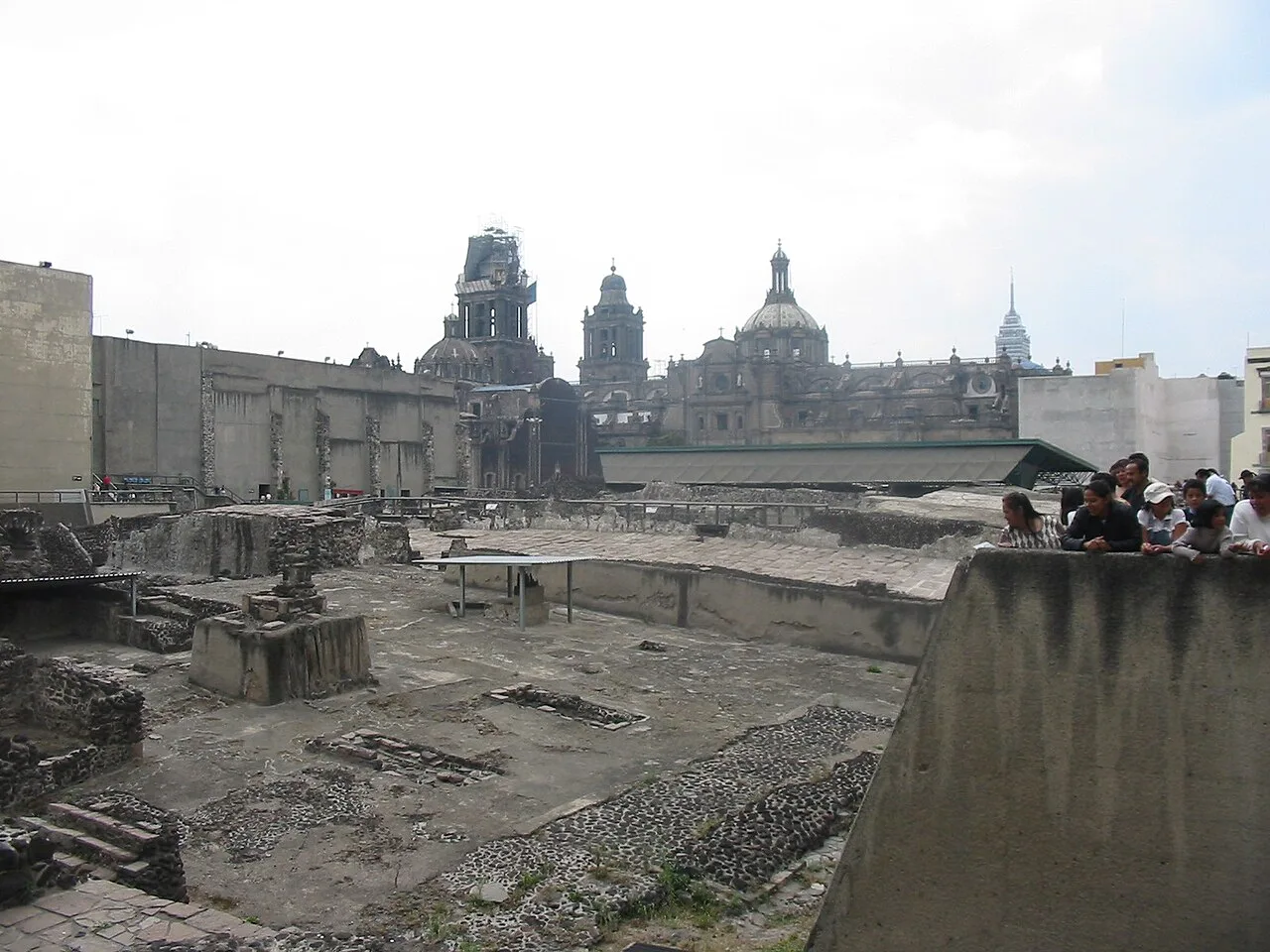
In the center of Mexico City, right behind the great cathedral, a jumble of stone stairways and walls lies open to the sky. This is the Templo Mayor, the "Great Temple." Five hundred years ago it stood at the heart of an island city floating in a wide lake. How did a city on the water turn into one of the largest cities on Earth? Start with the short video.

 Watch the one-minute video on YouTube
A city beneath the city
The Templo Mayor ruins sit beside the Zócalo, the main square of Mexico City's historic center. In 1987 the historic center and Xochimilco, to the south, were inscribed together as a UNESCO World Heritage Site. UNESCO describes the city as one "built in the 16th century by the Spanish on the ruins of Tenochtitlan, the old Aztec capital." Every street downtown, in other words, runs over the top of another city.
An island chosen by an eagle
The Valley of Mexico was once filled by a chain of connected lakes. According to Mexico's National Institute of Anthropology and History (INAH), they covered about 600 square kilometers. All the water left today adds up to less than 10.
Around 1325, the Mexica, the people often called the Aztecs, settled on a small island in Lake Texcoco. Their founding legend says that after long years of wandering, they knew they had found their home when they saw an eagle perched on a cactus.
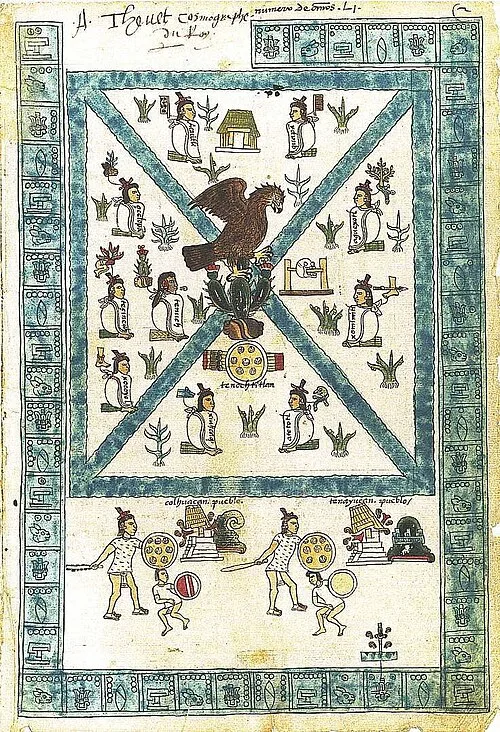

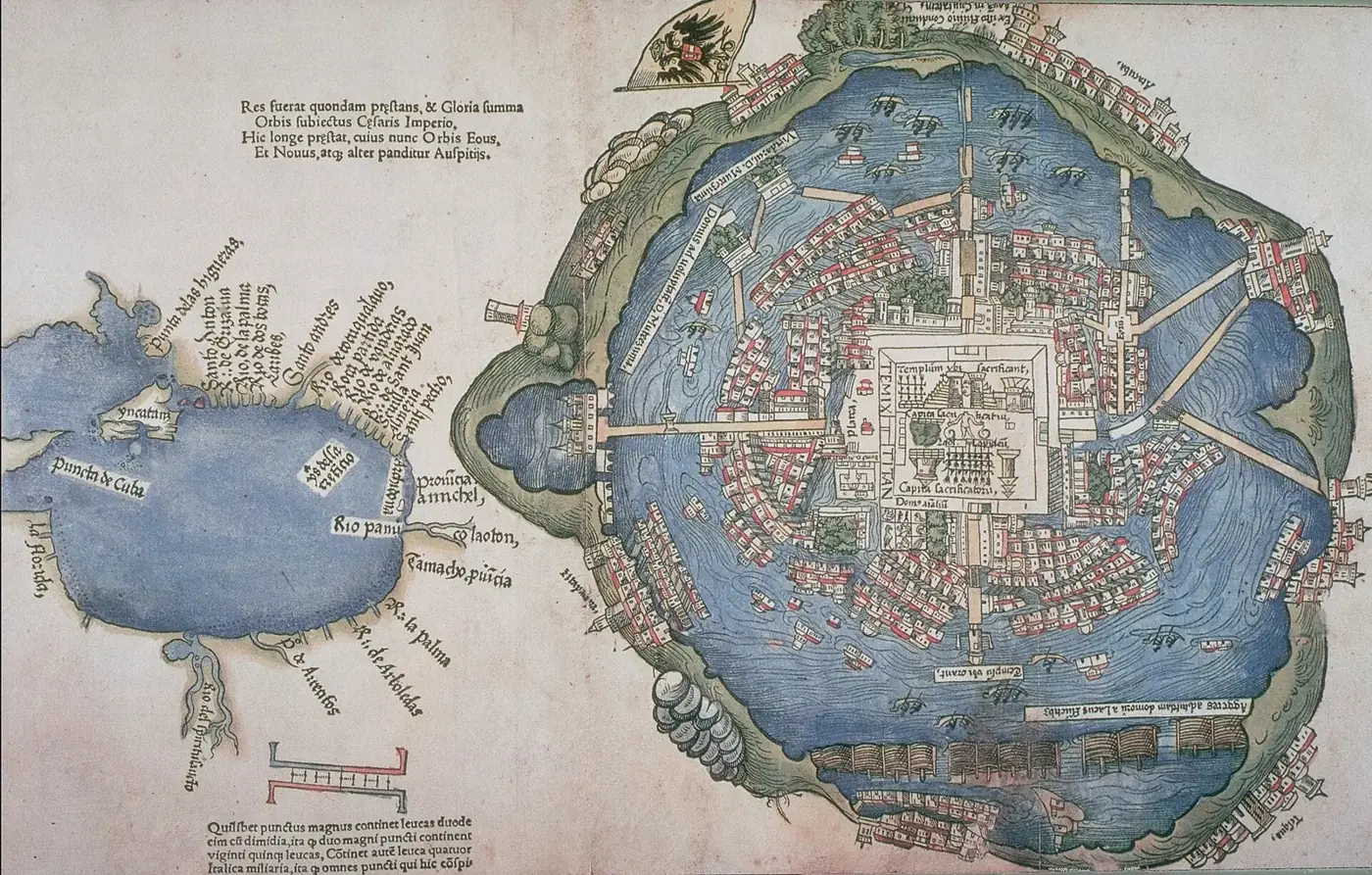
Long causeways tied the island to the shore, and narrow canals threaded through the city. People got around by canoe and farmed chinampas, garden plots built up from the shallow lake bed with heaped soil. A map printed in Nuremberg in 1524, only a few years after the Spanish arrived, still shows a round city sitting in the middle of the lake.

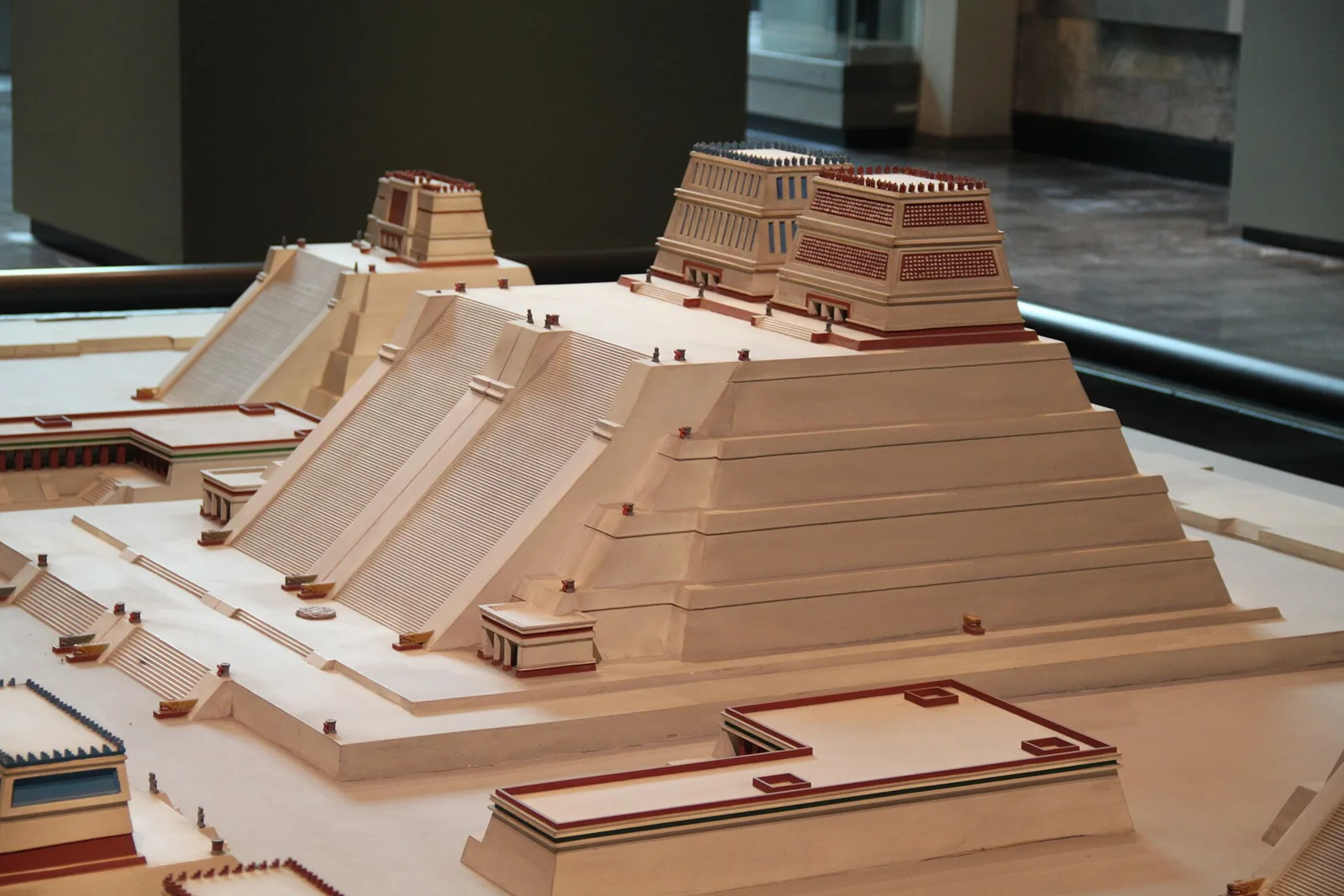
At its center rose the Templo Mayor. Two shrines stood side by side on top: the northern one for Tlaloc, god of rain, the southern one for Huitzilopochtli, the war god and patron of the Mexica. The temple was not built all at once; it grew through seven construction phases, each one larger than the last.

Ninety-three days
In 1519, Spaniards led by Hernán Cortés entered the city. Soon afterward smallpox, a disease the people of this land had never known, swept through the population. Many died, among them the ruler Cuitláhuac.
The Spanish did not fight alone. Indigenous states such as Tlaxcala and Texcoco joined them, and one account puts these allies at close to 80,000. The Spanish had boats taken apart, carried in pieces over the mountains, and reassembled on the lakeshore. In 1521 they closed in on the city from three causeways and from the water.
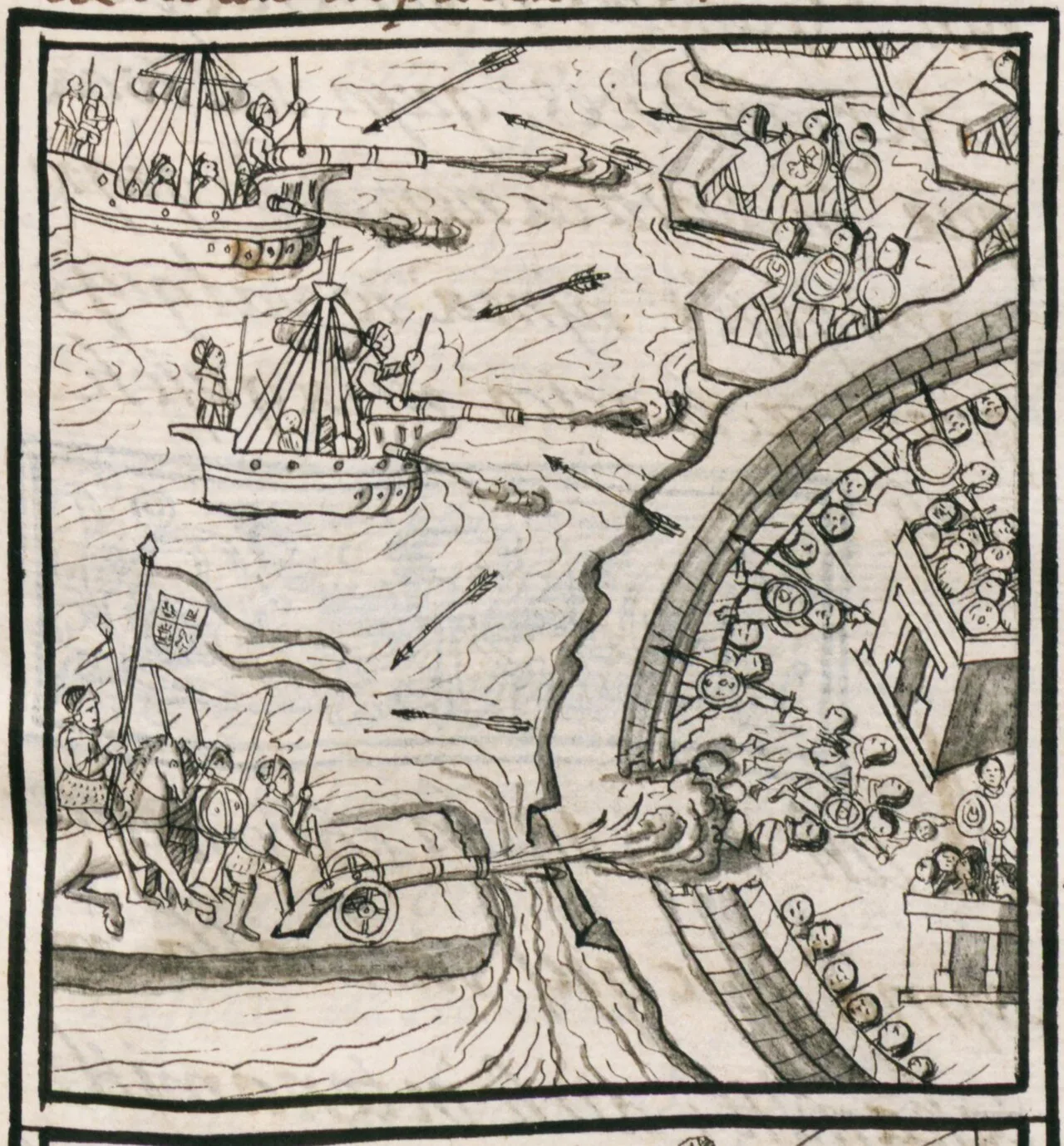

Food stopped coming in, and the salty lake water could not be drunk. Cuauhtémoc, a ruler just 22 years old, held the city for 93 days. The final fighting took place in Tlatelolco, Tenochtitlan's twin city. Cuauhtémoc was caught trying to escape by canoe, and on August 13, 1521, the city fell.
When the lake became land
On top of the ruined temples and houses, the Spanish raised European-style buildings, and they began draining the lake around the city. The work went on for centuries. INAH notes that large-scale draining began in 1750 and sped up over the two centuries that followed. As the lake bed dried out, the city spread across it and grew into today's Mexico City.
A stone found by electricians
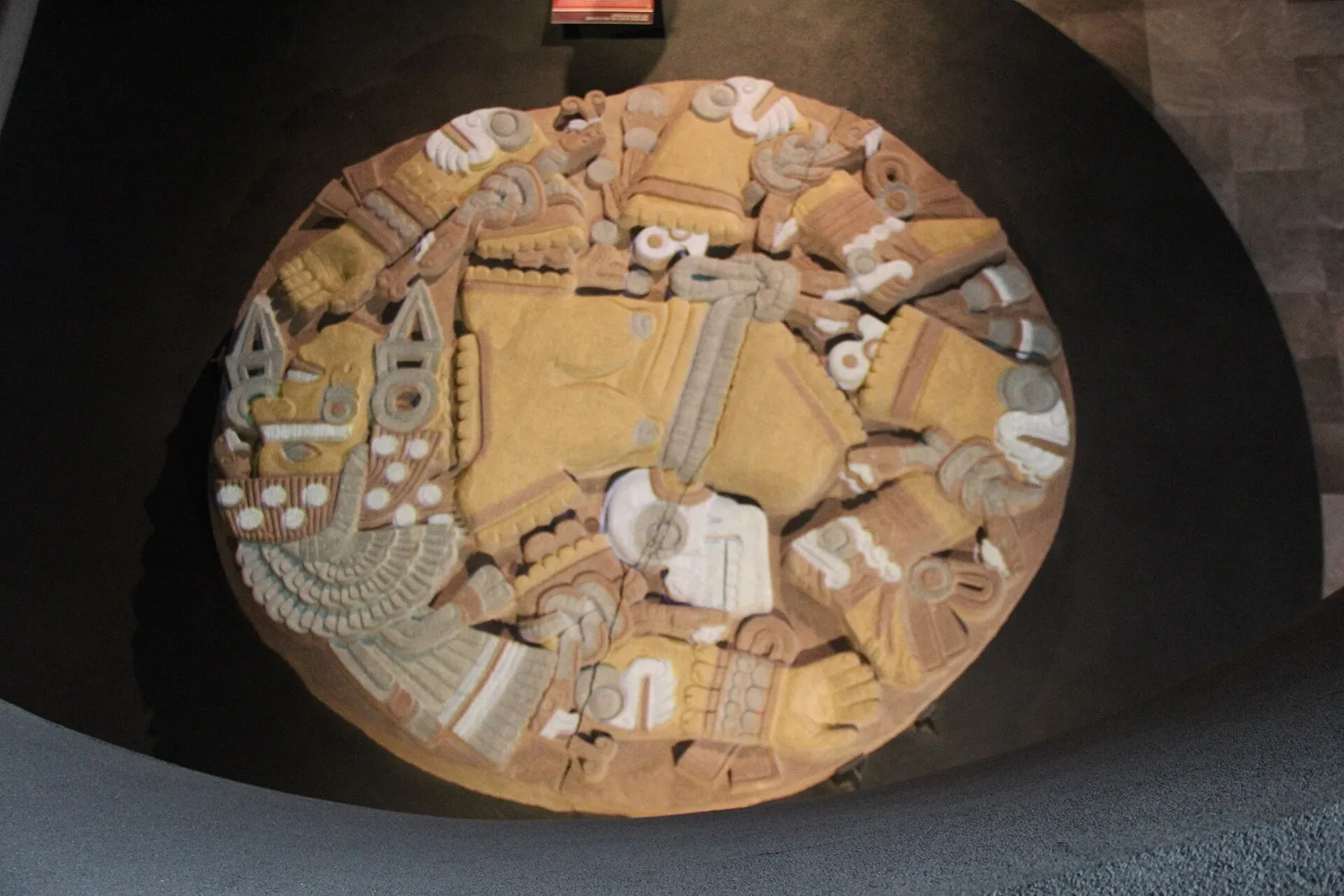
For centuries the Great Temple stayed buried. Then, before dawn on February 21, 1978, workers from the city's power company, digging between Argentina and Guatemala streets, struck a huge round stone carved with Coyolxauhqui, the moon goddess. INAH calls the find the start of one of the most emblematic projects in Mexican archaeology. Today the stone is on display in the Templo Mayor Museum.

Finding the old lake in Xochimilco
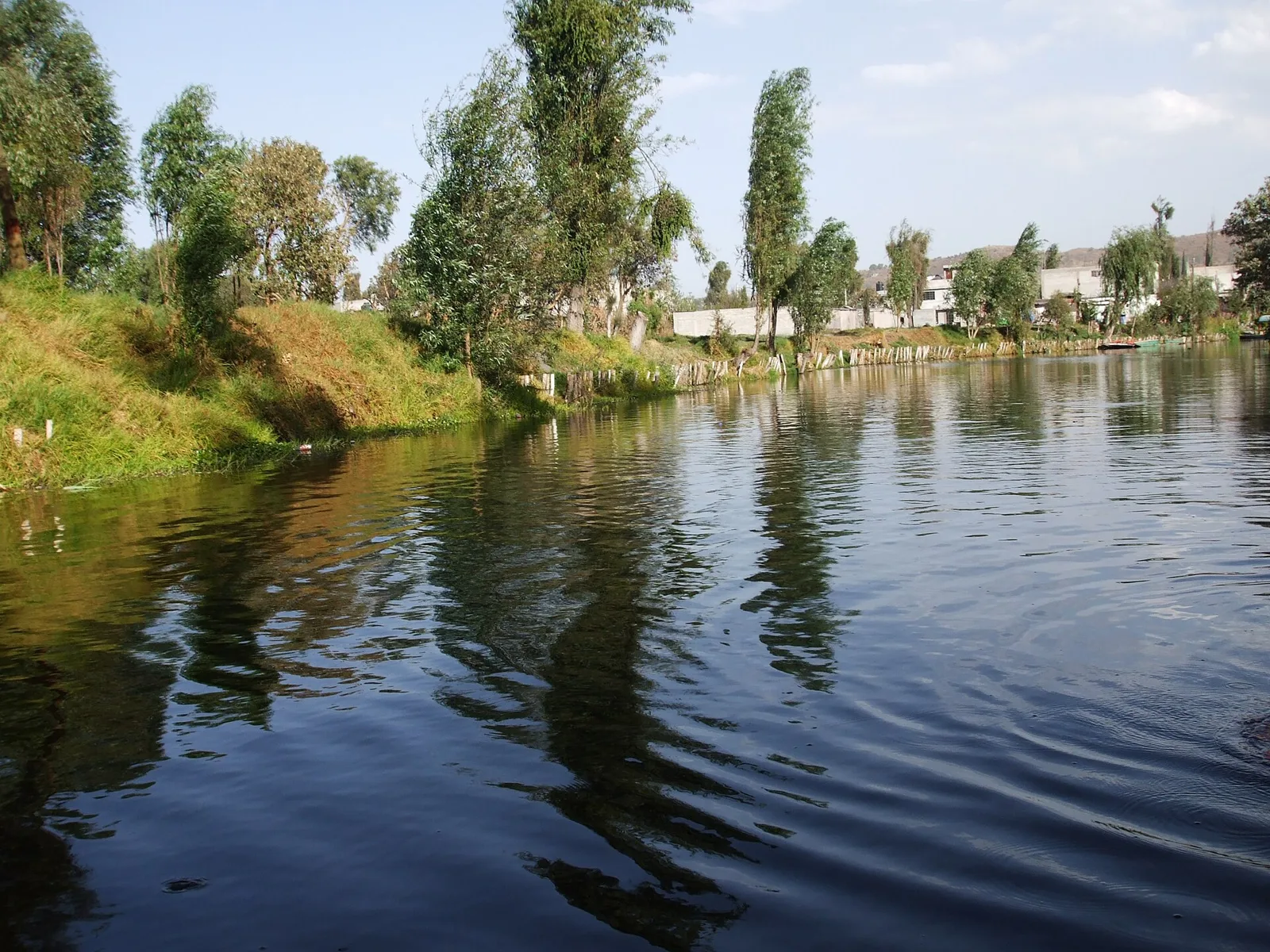
To get a sense of what the city on the water was like, head 28 kilometers south to Xochimilco. UNESCO calls it the only reminder of how people worked the lagoons of the Valley of Mexico before the Spanish came, and a few chinampas can still be found along its canals.

Find Tenochtitlan on Wooriyeojido
The Templo Mayor, once the heart of an island city, is pinned on the Wooriyeojido map. Look up Tenochtitlan in the app, and if you go, leave your photos and the story of your day right beside it.
View this place in the Wooriyeojido appVideos of nearby places
 Beneath a hole in a temple floor, a secret staircase: the tomb of King Pakal, Palenque
 Does a serpent crawl down the stairs at the equinox? The Temple of Kukulcán, Chichén Itzá
 Machu Picchu, the mountaintop city rediscovered in 1911
Sources
- UNESCO World Heritage Centre — Historic Centre of Mexico City and Xochimilco (412)
- INAH Lugares — Historic Centre of Mexico City and Xochimilco
- INAH — Boletín 392 (2022-08-12), el asedio naval a Tenochtitlan
- INAH — Boletín 391 (2025-08-14), resistencia mexica en Tlatelolco
- INAH — Boletín 316 (2025-06-30), Teocalli de la Guerra Sagrada
- INAH — Boletín 84 (2023-02-20), 45 años del descubrimiento de Coyolxauhqui
- INAH — Boletín 878 (2023-12-28), siete fases constructivas del Templo Mayor
- INPI (Gobierno de México) — Caída de la Gran Tenochtitlan (2021)